
Distance is one control, not the whole strategy
A remote-control arrangement can move an operator away from the immediate point of demolition. That can be valuable, but distance does not necessarily remove inhalation exposure, noise or the consequences of a structural event. Other people may remain closer to the hazard than the operator. A credible assessment therefore maps the whole affected area, including adjacent trades, building occupants, delivery personnel and members of the public. It also considers how those relationships change as work progresses.
The hierarchy of control remains relevant. Consider whether the task, material disturbance or exposure can be avoided or reduced before relying on personal protective equipment. The responsible project team decides the appropriate combination of engineering controls, work arrangements, monitoring and protective equipment. This article explains planning questions; it does not specify a safe distance, a protective-equipment selection or a control design for a particular site.
Treat dust as a health issue
Dust from concrete, mortar and other mineral materials can include respirable crystalline silica. The most hazardous fraction may not be visible. A visibly clearer room is therefore not proof that exposure is adequately controlled. In Great Britain, the Control of Substances Hazardous to Health Regulations 2002 provide an important legal framework. HSE construction dust guidance explains why assessment, suitable controls and checking performance matter. Other jurisdictions have their own requirements and exposure criteria.
Water suppression and extraction can be useful, but each depends on an appropriate design and practical management. Water can introduce slip, electrical, drainage and waste-water considerations. Extraction needs a suitable collection arrangement, airflow and maintenance approach. General ventilation does not automatically capture contamination at source. The control plan should address generation, spread, cleaning and waste handling rather than focus on the moment when an attachment contacts the material.
Separate noise, vibration and structural response
Noise and vibration are related to the task but require distinct assessments. A lower-noise attachment may still produce significant building-borne vibration, and a remote operator may still be exposed to harmful sound. The Control of Noise at Work Regulations 2005 apply to relevant occupational exposures in Great Britain. BS 5228 addresses noise and vibration control on construction and open sites within its scope. It supports assessment; it does not give blanket approval for a proposed method.
Where retained fabric or neighbouring uses are sensitive, establish the relevant baseline, assessment criteria and response process with competent specialists. BS 7385-2 is one reference concerning evaluation of vibration in buildings, but its scope and limitations need proper interpretation. A generic threshold copied from another project can be misleading. Occupant disturbance, sensitive equipment and structural concerns may require different criteria and different evidence.
Make the exclusion arrangement understandable
Exclusion planning accounts for machine movement, attachment reach, falling or ejected material and the possibility of unexpected events. The required boundary is not defined by the length of a remote-control cable or by an arbitrary circle around a machine. It should follow the task assessment and the building context. Access arrangements must also make sense during deliveries, maintenance, cleaning and changes between work areas, when normal boundaries can become unclear.
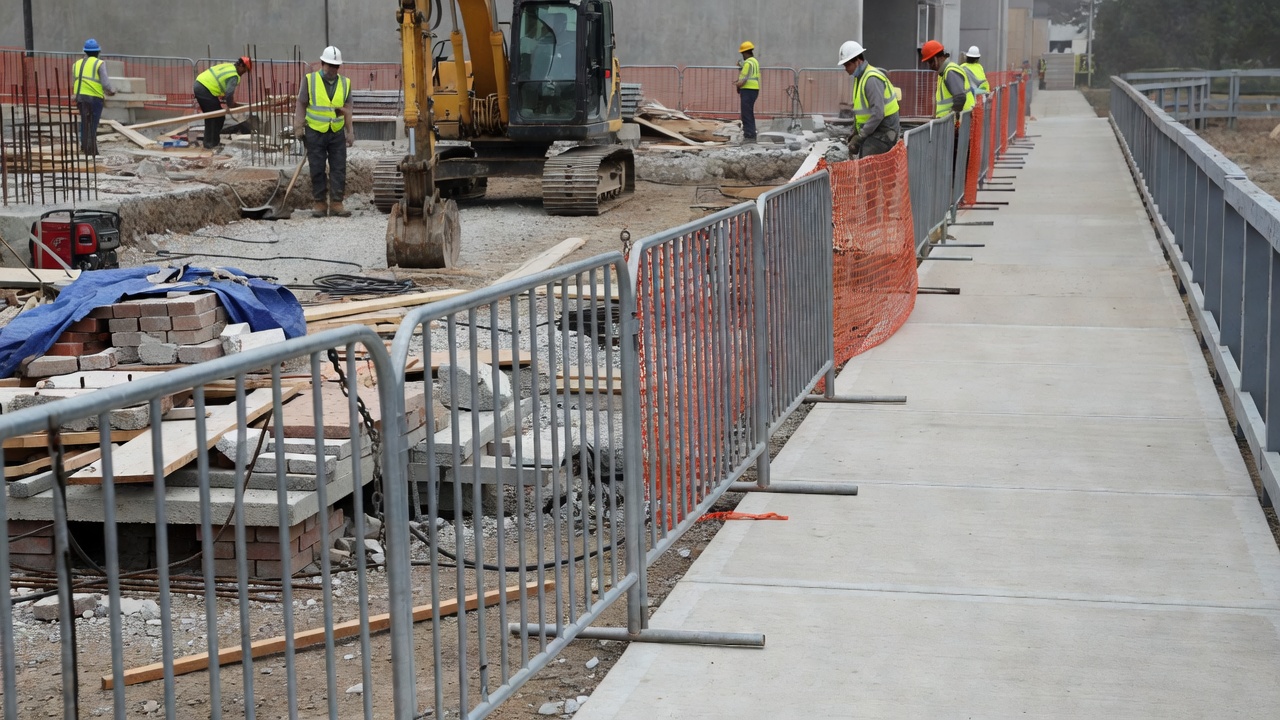
Visibility and communication are part of this system. Remote control does not guarantee that every relevant area is visible from one position. Dust, obstructions, lighting and noise can change what the operator and surrounding team can perceive. The competent contractor must determine suitable arrangements and responses to lost visibility or communication. Planning should make responsibility clear without turning a general editorial guide into an operating procedure.
Consider the surrounding building
An occupied building may share ventilation, drainage, service routes or escape arrangements with the work area. Contamination can move through paths that are not obvious from a floor plan. Hospitals, laboratories, schools and residential buildings can introduce particular sensitivities, but the relevant requirements must be established with the people responsible for those premises. No building type should be assumed compatible merely because a compact machine can physically fit inside it.
Health and environmental specialists may draw on resources from the British Occupational Hygiene Society, the Institute of Acoustics and the Environment Agency, according to the question and jurisdiction. ISO 45001 offers an occupational health and safety management framework; certification is not evidence that a specific exposure is controlled. Distinguish management-system assurance from task-specific assessment, measurement and review.
Plan how control failure will be recognised
A control plan needs an owner, a way to check that arrangements are working and a defined response when conditions change. Monitoring should answer a clear question rather than generate numbers without interpretation. Explain who receives results, who can require reassessment and how affected people are informed. Complaints and unexpected observations can reveal a gap, but they should not be the only means of detecting one. Effective planning connects equipment, people and evidence before the first task begins.
Reference starting points
Read HSE construction dust guidance, resources from BOHS and the Institute of Acoustics, and Environment Agency information. Check standards through BSI or ISO.