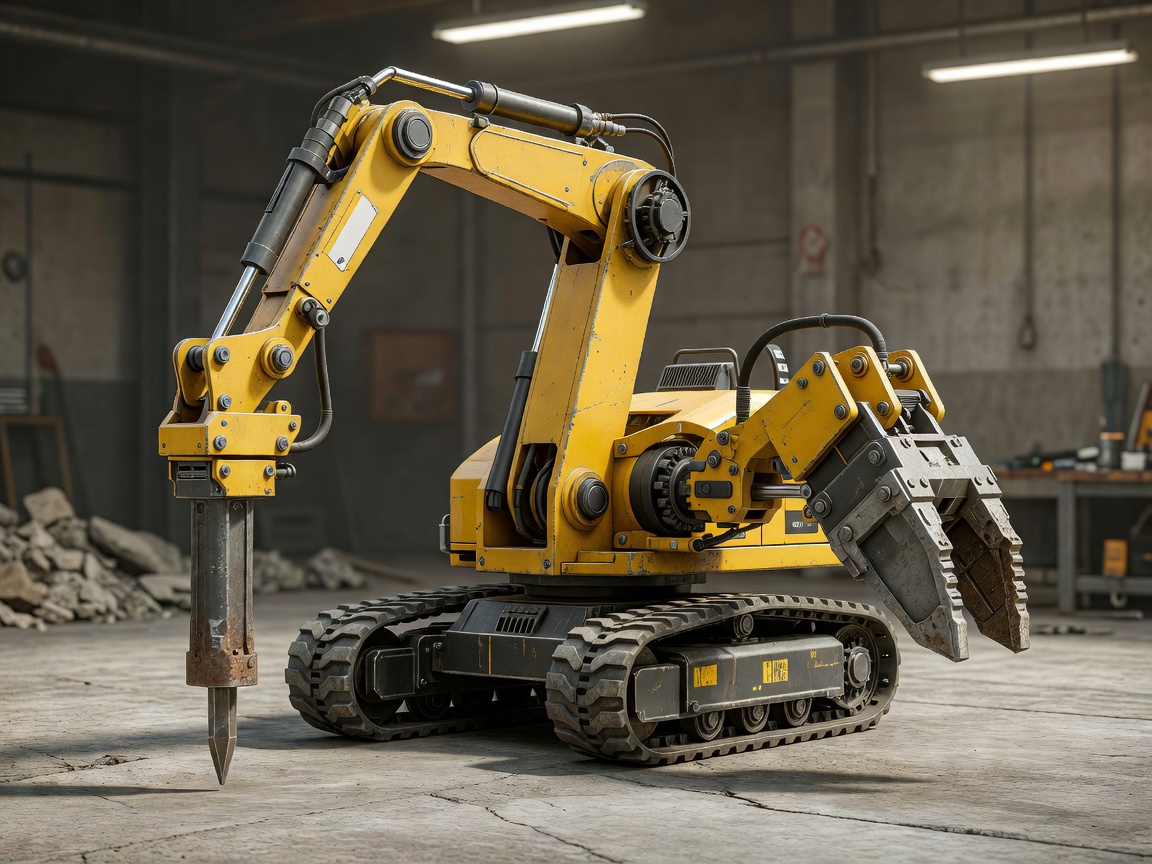
Start with the route, not the reach
A machine has to reach its working position before its arm can reach the material. The route may include vehicle unloading, a pavement interface, doors, ramps, lifts and changes in floor level. Every transition introduces a different constraint. Record clear dimensions and turning space, but also identify bearing surfaces, vulnerable finishes and interfaces with people. A route that fits geometrically may still be unsuitable because its load capacity or management arrangements have not been established.
Transport dimensions and operating dimensions are not interchangeable. A folded arm can pass through an opening that does not provide enough space for working. The configuration used to obtain a quoted reach may require a particular support arrangement. Ask the supplier to identify which dimensions belong to which configuration. Do not infer that a machine can operate safely simply because it can enter the room.
Compare complete systems
Brokk and Husqvarna Construction manufacture remotely operated demolition equipment. Their ranges illustrate why the machine category alone is not a specification: carriers vary in mass, available reach, power arrangements and attachment compatibility. Darda and Epiroc supply demolition attachments across their product portfolios. These names are reference points, not a shortlist or endorsement. Compatibility must be confirmed for the exact carrier, attachment, hydraulic requirements and intended task using current technical documentation.
The planning comparison should also include supporting equipment. Electrical supply capacity, cable management, water provision, extraction equipment and charging or refuelling arrangements can influence feasibility. Remote control does not mean autonomous working, and an electric drive does not remove every emission source on a project. Delivery vehicles, ancillary machinery and material-handling equipment may introduce separate requirements. The appropriate boundary is the work system, not the robot in isolation.
Understand what the attachment changes
Different attachments transfer force differently and create different downstream demands. Breaking can generate fragments and impulsive noise; crushing can change fragment size and reinforcement handling; sorting equipment can support material separation. None is universally quieter, cleaner or more appropriate. Material composition, geometry, access and the surrounding structure influence performance. A trial or specialist review may be needed where the response of the material is uncertain.
| Family | Planning interest | Evidence to request |
|---|---|---|
| Hydraulic breaker | Impact, fragments, noise and vibration | Task suitability and exposure-control assessment |
| Concrete crusher | Access around the element and material response | Compatible configuration and structural review |
| Sorting or handling tool | Material separation and movement | Permitted duties and handling limitations |
A tool described as suitable for concrete does not establish that a particular wall or slab can be removed. Reinforcement, embedded services and load-bearing function remain separate questions. Attachment selection should follow the structural and materials assessment rather than replace it. This distinction prevents a productive tool from being mistaken for a complete method.
Separate mass from loading
Machine mass is only one input to floor assessment. The engineer may need operating configuration, contact arrangement, attachment reactions, movement effects, temporary supports and the intended position of debris. The delivery route also needs consideration. Quoting a floor’s original design use does not demonstrate suitability for demolition plant, particularly when deterioration or previous alterations are possible. The competent assessor decides which information and checks are necessary.
ISO 12100 provides a framework for machinery risk assessment and risk reduction, while ISO 20474 addresses safety requirements for earth-moving machinery within its scope. These references do not certify a building’s suitability or replace model-specific instructions. Their relevance must be checked for the equipment and jurisdiction involved. A useful procurement record distinguishes manufacturer obligations, contractor planning and the project engineer’s structural decisions.
Make uncertainty visible in procurement
Ask suppliers to state assumptions rather than provide an unqualified “yes”. A proposal should identify what is included, which site facts it relies on and what would trigger a change. Consider the availability of trained operators, maintenance support, attachment inspection and recovery arrangements as well as nominal productivity. Programme estimates should acknowledge uncertain material behaviour, restricted working hours and waste movement. Selecting the smallest quoted cost before resolving these issues can simply move uncertainty into the work stage.
The final machine decision should be traceable to a verified task and an agreed method. Where the route, floor condition or required attachment remains unknown, record the selection as provisional. That is a useful planning outcome, not a failure to choose. The next step is to obtain evidence, not to compensate with confidence.
Reference starting points
Consult current information from Brokk, Husqvarna Construction, Darda, Epiroc and the ISO standards catalogue. Product ranges and applicable editions can change.